Results from PCORnet® Bariatric Study Published in JAMA Surgery

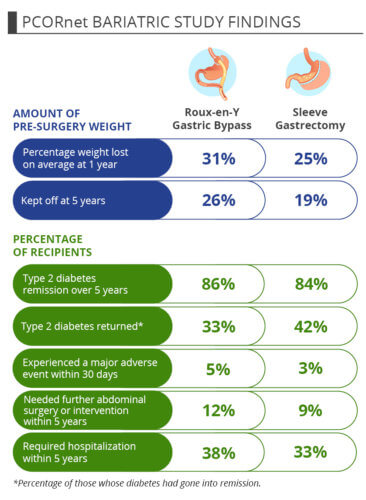
There were no differences in all-cause mortality between patients who had sleeve gastrectomy or Roux-en-Y gastric bypass (RYGB), but operations, hospitalizations, and other longer-term problems were more often associated with RYGB than sleeve gastrectomy, according to a new JAMA Surgery paper reporting results from the PCORnet® Bariatric Study.

The paper describes how researchers used resources from PCORnet, the National Patient-Centered Clinical Research Network, to build a cohort of over 33,000 patients who underwent one of these two different types of bariatric surgery. Researchers were able to investigate the rates of longer-term problems up to five years after patients had their bariatric surgeries.

In an audio interview, study author Anita Courcoulas, MD, MPH, FACS, said that this research was different from past studies in that, by using PCORnet, researchers were able to leverage real-world clinical data from electronic health records and link that data to insurance claims data and other sources.

This information will help guide patients and their doctors in making important decisions about bariatric surgery as they weigh the rates of potential risks associated with each procedure and the average amount of weight loss produced by each, she noted. Study findings on how much weight patients lost and kept off were published in an earlier paper in the Annals of Internal Medicine.

Courcoulas also discussed the important role that bariatric patients, including co-investigator Neely Williams helped in shaping and guiding the study at every step.

PCORnet Leader Rainu Kaushal Elected to Prestigious National Academy of Medicine

Dr. Rainu Kaushal wears many hats. She serves as the principal investigator for INSIGHT-NYC, a Partner Network of PCORnet®, the National Patient-Centered Clinical Research Network; chair of the Department of Healthcare Policy and Research at Weill Cornell Medicine; physician-in-chief of healthcare policy and research at New York-Presbyterian/Weill Cornell Medical Center, and a member of the PCORnet Steering Committee. Now, in recognition of her outstanding achievements and exceptional service in medical sciences, healthcare and public health, Dr. Kaushal is donning a new hat, that of an elected member of the National Academy of Medicine (NAM). NAM members are selected by their peers, and membership is one of the highest honors in health and medicine.

“I’m incredibly honored to have been elected to the National Academy of Medicine, which is such an important institution for improving health and informing healthcare policy,” said Dr. Kaushal. “My work with PCORnet has influenced many of the efforts NAM cited in their recognition, so I owe thanks to the numerous colleagues across my PCORnet family who have inspired me, challenged me, and made my science better over the years.”

For more than 25 years, Dr. Kaushal has made significant contributions to pediatric patient safety, health information technology, and value-based healthcare delivery. An information scientist and health services researcher, Dr. Kaushal’s work has influenced healthcare policies and the clinical research landscape in the United States. She was a founding member of the INSIGHT-NYC and a key contributor in helping build and expand PCORnet’s infrastructure since the Network was launched. Results from a PCORnet-enabled study she led that characterized patients with preventable high care utilization attracted over $500,000 in cost-matching from three health systems and inspired changes in population health management programs nationally.

“So many of the principles I’ve learned developing and building a clinical research network have complemented and improved my work,” said Dr. Kaushal. “My affiliation with PCORnet has without a doubt helped bring more patient-centeredness into my research, and it has been rewarding to watch the development of the Common Data Model and PCORnet’s data linkages to other sources continue to grow.”

Dr. Kaushal earned her medical degree from Harvard Medical School and completed her clinical residency as an inaugural resident at a combined program at Brigham and Women’s Hospital and Children’s Hospital in Boston, becoming board-certified in both internal medicine and pediatrics. An author of over 200 papers in various scientific publications, Dr. Kaushal is a frequently invited speaker at national and international meetings as an expert on patient safety, healthcare information technology and value-based care. Her many awards and recognitions include selection in the Executive Leadership in Academic Medicine program and being named one of the Crain’s Notable Women in Healthcare in New York City in 2018.

Patient Reps Power PCORnet’s Steering Committee: A Q&A with Henry Cruz

If you are looking for a reason to get excited about the promise of PCORnet®, the National Patient-Centered Clinical Research Network, look no further than Henry Cruz. He’ll give you 10, and you’ll leave your encounter with him energized and in awe of a guy who grew up the youngest of 12 kids in a low-income community in Brooklyn and now lives in Harlem where he works to bring better community and patient engagement to clinical research. Henry serves as a powerful patient advocate for bringing communities into the research fold. From delivering keynote speeches across Asia and Africa to co-authoring a peer-reviewed article on patient engagement for the American Heart Association, Henry’s life is a lesson in how a single voice can amplify a movement, build a coalition, and make a meaningful difference in the way patients and researchers engage. Now, he’s joined PCORnet’s Steering Committee as one of three patient representatives. Here’s his perspective on his role and why it matters:

What inspired you to take on an active role in clinical research?

I am the youngest of 12 children, and we all have diabetes. Today, there are only three of us alive. Watching our family be impacted over and over again by the same disease made me realize that as patients, we cannot sit back and wait for the answers to come. We have valuable insights that, when paired with research expertise, can move the needle on chronic conditions like diabetes faster than the research community can alone. I began working closely with physicians at Montefiore Medical Center to manage my diabetes and with innovative researchers who restored sight in my left eye. It was this exposure to researchers where I developed respect for the value and impact of clinical research and those who work in this field.

How did you come to partner with the PCORnet Community? 

After consulting as a patient representative for Sanofi, Norvo Nordisk, and others for more than 20 years, my partnership with INSIGHT (formerly the New York City Clinical Data Research Network) connected me to the PCORnet Study, ADAPTABLE. I was amazed. The study team was taking a totally new approach to engage a team of patients as partners, empowering them to give input across the study lifecycle. I had previously served on other studies as a patient representative, but for the first time in my life, I played a central and active role in the research process. I was not only invited to the table as a collaborator, but my ideas and opinions were respected—and sometimes helpful!

Because of ADAPTABLE, my worldview on the patient’s role in research changed profoundly. It has been one of the most amazing health experiences of my life, and I became vocal about my passion for helping to implement this approach more widely across research. Fortunately for me, the stakeholders driving PCORnet are passionate about it, too. When they asked me to join the Steering Committee as a patient representative, I didn’t hesitate. It was an immediate “yes.”

What excites you about PCORnet? 

In my life, I have come across many, many organizations that advocate the value of “patient-centered research.” The problem is, it was no more than that—a phrase, a thing to say, but not a practice. But that’s not the case within the PCORnet community, which is clear across literally every stakeholder I’ve encountered. PCORnet is a community of people who see patients as partners. At our Steering Committee meetings, I joke that I’m from Brooklyn living in Harlem sitting around a bunch of academic nerds. But that’s what makes PCORnet so groundbreaking! They are changing the way the clinical research community sees patients. They are changing the way we see ourselves. I am humbled to collaborate with these people.

Watching the infrastructure of PCORnet grow excites me nearly as much as the people. I think of the Network as train tracks, crisscrossing the United States and connecting hundreds of learning institutions. It hasn’t been done before now, and it is changing the way research is conducted. Everyone knows we need to find ways to make research faster and less expensive. With PCORnet, we are making it happen, and that is tremendously exciting.

How does your perspective add value to the research process? 

The clinical research community is filled with incredibly bright people, but the lived experience of a disease or condition is something that can’t be taught in textbooks. Patients need researchers, and researchers need patients. It’s a partnership. I remember a big moment during one of the first studies I consulted on, a pulmonary trial being conducted through New York University. I went to meet with the principal investigator, who let me know right away that he was meeting with me as a “patient input” requirement of the study. But I’m not shy, so I held my ground, asked questions, and challenged the areas of the protocol I felt merited a second look. As the meeting ended, the investigator slammed his binder closed and said, “You have completely undone our research.” Then, after a beat, he smiled. “But I’m glad. You’ve made it better.”

Since that time, PCORnet and other patient-centered resources have gone a long way toward proving the usefulness of the patient voice across the research community, but this anecdote is still an important reminder to me of the true value of community collaboration. Patients look at a protocol from a different perspective than a researcher, and we can spark ideas and insights that matter. As a patient, this is incredibly validating. Working as a patient partner has unlocked opportunities to put the advocacy I’ve championed for decades into action. It’s next level, and very exciting.

What would you like other patients looking to engage in research to know? 

Don’t be intimidated, and don’t sell your lived experience short. Research needs you, and now, thanks to communities like PCORnet, there is a place for you here. Reach out and learn how you can get involved.

This is part one of a three-part series highlighting patient partners on PCORnet’s Steering Committee. Be on the lookout for future Q&As featuring Neely Williams and Kiely Law.
Newly Funded Statin Pragmatic Trial to be Fueled by PCORnet® Resources and Informed by the Network’s Past Success

PCORnet® will play a major role in the largest pragmatic trial with placebo-controlled drug assignment to date and first statin trial with a non-cardiovascular primary outcome.

PCORnet®, the National Patient-Centered Clinical Research Network, will serve as a key resource for a new pragmatic trial studying effectiveness of statins in older adults without known cardiovascular disease. The National Institute of Aging and the National Heart, Lung, & Blood Institute will support the trial, recently announcing funding of $90 million to bring it to life.

The study, known as PREVENTABLE (Pragmatic Evaluation of Events and Benefits of Lipid-Lowering in Older Adults), will use PCORnet resources and the National Veterans Affairs (VA) Network to recruit 20,000 participants aged 75 or older at 100 U.S. sites. The study will identify outcomes via electronic health records.

PREVENTABLE represents the largest pragmatic trial to date with placebo-controlled drug assignment and the first statin trial conducted with a non-cardiovascular primary outcome. Investigators will instead study whether statins help older adults avoid new dementia or physical disability.

“Few statin studies in primary prevention populations have included individuals aged 75 or older, leaving many unanswered questions for older adults,” said Renee Leverty, program lead for Stakeholder Engagement at Duke Clinical Research Institute (DCRI), which will serve as the coordinating center for PREVENTABLE. “PCORnet and the VA Network are large, national resources with complementary strengths and established ties to the 75-plus community. We expect that this collaboration, combined with the powerful engagement tactics this study will deploy, will allow PREVENTABLE to bring important answers that will help this population make better-informed choices for their health.”

A PCORnet-inspired patient engagement strategy

The PREVENTABLE team will not only leverage PCORnet data resources, but also tap the successful patient engagement strategies deployed by previous PCORnet-enabled studies. For example, beginning in 2015, the ADAPTABLE study used the Network resources to embrace a new paradigm of patient and provider engagement in clinical research, successfully recruiting more than 15,000 participants. PREVENTABLE will use learnings from ADAPTABLE and will involve its DCRI principal investigators, Adrian Hernandez, MD, MHS, and Schuyler Jones, MD, throughout the study. Hernandez also serves as the principal investigator for the PCORnet Coordinating Center. Engagement strategies inspired by ADAPTABLE include:

  • Embedding research in the health care system by enrolling patients in their usual care settings and in partnership with their primary care providers.
  • Establishing a Participant Advisory Group to give feedback on the protocol, e-consent, understanding the participant journey, recruitment and retention plans, participant experience, patient-reported outcomes, community engagement, and dissemination of results.
  • Including Patient Engagement Representative Neely Williams on the PREVENTABLE Steering Committee and other engagement initiatives. Williams served as co-principal investigator on the PCORnet-enabled Bariatric Study and is a member of the PCORnet Steering Committee.
  • Ensuring informational videos, recruitment materials, and the study’s e-consent platform have been tested by patients, community groups, and clinicians.

PREVENTABLE will also deploy funded community partner awards, an engagement tactic inspired by the National Institutes of Health’s All of Us Research Program’s Community & Provider Gateway Initiative. These awards will support engagement and retention of participants, who may otherwise get to participate in research. Financial support will be provided to organizations and groups with trusted relationships and demonstrated success in engaging these communities.

PREVENTABLE will be funded over 7 years. More information about PREVENTABLE is available via the National Institute on Aging, the DCRI, and PCORI.