Meaningful engagement with patients, caregivers, clinicians, and the broader healthcare community is foundational to PCORnet.
To support this, patient and community partners led the development of the PCORnet® Common Engagement Model (CEM).
The Common Engagement Model is the set of minimum expectations that PCORnet® Studies should use to support meaningful engagement in research conducted using PCORnet. PCORnet® Studies engage patients, caregivers, and other partners who represent a broad range of perspectives and lived experiences across age, culture, ability, geography, education, health conditions, and other factors, with particular attention to those most affected by the research topic or focus area.
By using the CEM elements, research teams ensure that patients, caregivers, and other partners across the healthcare community are meaningfully engaged throughout the research process—from identifying the questions that matter all the way through to the dissemination of research results.
Three ways to get started
- Contact the PCORnet® Front Door to learn how to apply the CEM in your research study.
- Review the PCORnet® Playbook, your guide to using PCORnet to support patient-centered health research. This resource has modules on meaningful patient engagement and cases studies of successful PCORnet® Studies.
- Search the Knowledge Repository for best practices on engaging stakeholders throughout the research process.
Read On
Patient partners who serve on the PCORnet® Steering Committee reflect on the values of the PCORnet® Common Engagement Model and call for deeper patient engagement across all health research. Read the commentary.
Core Elements of the CEM
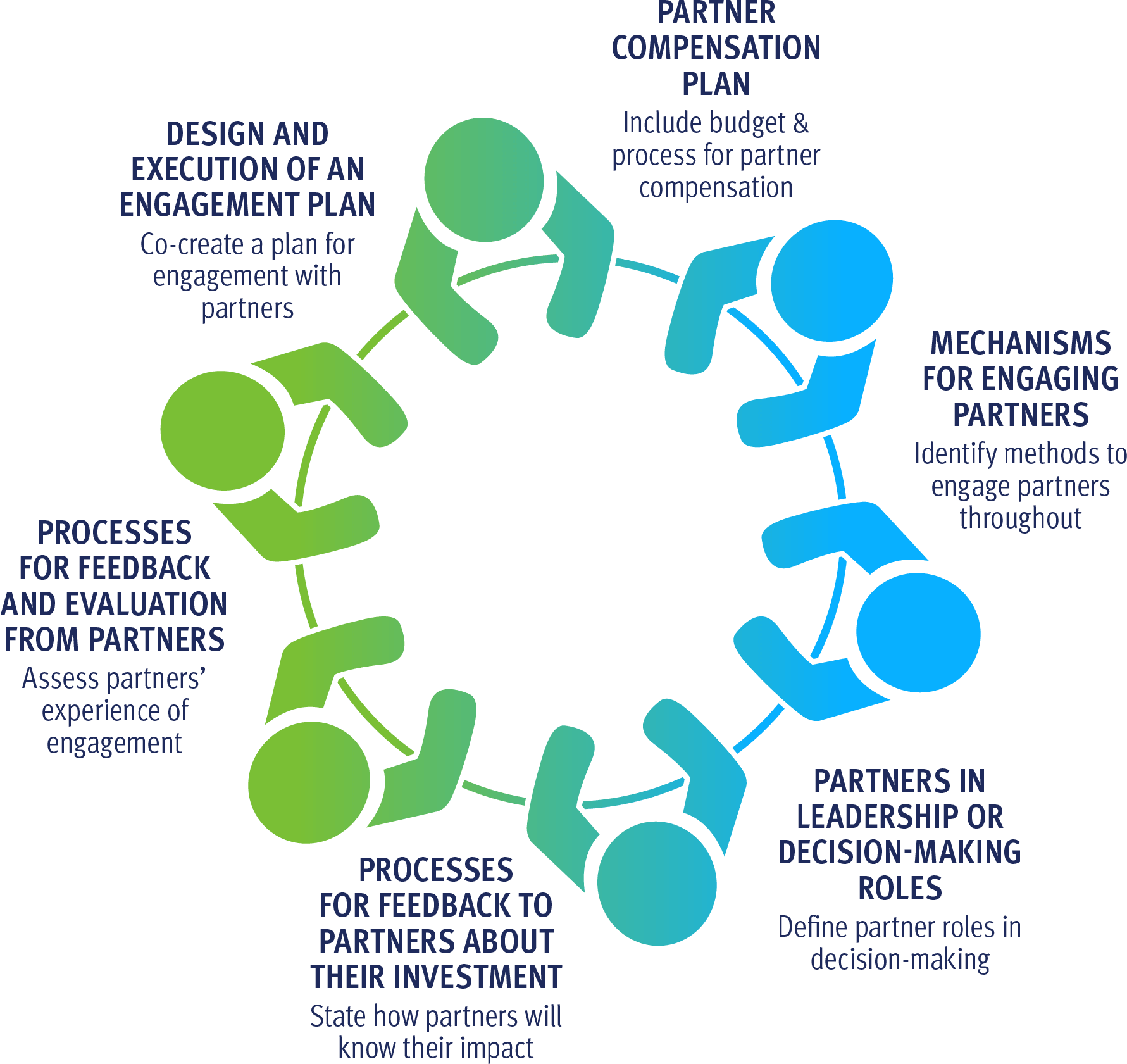
Engage partners in co-creating and executing an engagement plan. Every PCORnet® Study team should consider all CEM elements. Engagement plans should document how each element will be addressed, including justification for any elements that are not applicable or appropriate for the study.
Budget adequate funds for compensating partners who are engaged with PCORnet® Studies for their time, including for preparation, participation, and follow-up. Partner input should be reflected in the chosen form(s) of compensation. Describe the process for compensation, including funding flow and relevant institutional policies.
Identify methods to engage patients, caregivers, and other partners throughout the study lifecycle, including priority setting, study design and implementation, and study results and dissemination.
Ensure your planned approaches span the engagement continuum (inform, consult, collaborate, decision making).
Example methods include surveys, interviews, group discussions, review of study materials, co-design activities, and participation in committee or study team meetings.
Provide adequate onboarding, training, and technological support related to engagement and project participation to all patients, caregivers, and other partners as well as the research team.
Describe how patients, caregivers, and other partners will participate in study decision-making and any leadership or governance roles.
Example roles include investigator, executive committee member, or advisory council member.
Define mechanisms to gather partner feedback on their engagement experience and use it to improve engagement activities. Evaluate engagement using metrics (e.g., meeting participation, responsiveness) and structured feedback methods such as validated engagement evaluation measures, surveys, interviews, or group discussions.
Describe how partner engagement will shape the study across its lifecycle and how partners’ impact will be communicated back to them. Partner input can improve study questions, study design, recruitment, retention, selection of outcomes and measures, data collection and analysis, and interpretation and dissemination of study results.
Applying the PCORnet® CEM
 Each research study is unique, so the engagement approach and activities for a PCORnet® Study may differ from those used by other study teams.
Each PCORnet® Study, regardless of study design, should use the Common Engagement Model to guide engagement throughout the research process, incorporating approaches that are appropriate for the study and meaningful to partners.
By applying the CEM, research using the PCORnet infrastructure will remain patient centered and informed by the lived experience of patients, caregivers, and others in the healthcare community.
The intervention trial PRECIDENTD, a PCORnet® Study funded by PCORI, has a comprehensive engagement strategy. Its plan includes partners on the executive committee, regular advisory council meetings, feedback on study design, messaging, materials, and an annual evaluation process with validated engagement measures and group discussion. In addition, partners in this study co-designed a centralized text message-based tracking and support program. Read the article.