PCORnet® Gives Reason to Celebrate Connection and Community this Clinical Trials Day

As COVID-19 pandemic continues to spread, keeping many across the world at home and disconnected from their communities, PCORnet®, the National Patient-Centered Clinical Research Network, is rallying to build coalitions and deliver hope. May 20 is Clinical Trials Day, a time to remember that clinical research has always been about bringing together people to build a healthier world—and in the era of COVID-19, patient engagement in research is more important than ever.

May 20 is commemorates the day James Lind performed the first-ever clinical trial in 1747, which was focused on scurvy. While it is a day to applaud Lind’s work in paving the way for future clinical trials, it is also fitting to celebrate the communities—clinicians, health systems, patients, and caregivers—who have propelled medical innovations forward since that time. Collaborative research has disarmed numerous diseases that were once a threat to global survival, but today are largely contained. Now, research is tackling the challenge of COVID-19, and PCORnet is enabling two opportunities for communities to come together to find answers.

  • The Healthcare Worker Exposure Response & Outcomes (HERO) Registry is a large, national clinical research community. It invites healthcare workers across America to share clinical and life experiences to understand the perspectives and problems they face on the COVID-19 pandemic front lines.
  • Those registered in the HERO Registry may have the opportunity to participate in HERO-HCQ, a randomized clinical trial of approximately 15,000 HERO Registry participants. It will test whether hydroxychloroquine can prevent COVID-19 infection in healthcare workers.

While there is still much unknown about the novel coronavirus, one thing is clear: clinical research is the best hope for answers. This Clinical Trials Day, celebrate the power of community, and if you are someone working in a healthcare setting that is caring for people with COVID-19, consider participating in the HERO registry by following the registry link above.

PCORnet® COVID-19 Common Data Model Launched, Enabling Rapid Capture of Insights on Patients Infected with the Novel Coronavirus

COVID-19 has upended life globally, and the need for patient-centered insights and answers has never been more pronounced. Leadership of PCORnet®, the National Patient-Centered Clinical Research Network, is responding with bold action by creating a COVID-19-specific Common Data Model (CDM). The new CDM will allow researchers to use information gathered from patients across PCORnet’s vast network to better define and understand who is getting infected with SARS-CoV-2 and how the virus affects them.

“PCORnet is one of very few data resources with the scope and infrastructure to support the nation’s needs for fast answers to important questions during this pandemic,” said Keith Marsolo, who is co-leading the development of the CDM. “We are unleashing the Network’s full potential to combat this crisis, and that includes the development of a COVID-19-specific CDM that transforms data across the Network into a research-ready state to power critical studies and rapidly inform the nation’s response.”

CDMs standardize millions of data points generated from patient visits at clinics and hospitals into a common language that can be used for research while securely protecting personal patient information behind firewalls. Development of a CDM specific to COVID-19 is important because a lot of the existing data on patients with COVID-19 has come from varied sources, which lack the rich clinical details that the research community needs to determine the best response to this pandemic.

“Patients are seeking meaningful answers to the COVID-19 pandemic, and that is going to require an in-depth look at who this virus infects, how it spreads, and how it responds to treatment,” said Pastor Bruce Hanson, patient advocate. “This new CDM enabled by PCORnet will set the stage for that type of research, unlocking details that will empower our nation to address the pandemic as swiftly and accurately as possible.”

To ensure they are keeping pace with the fast-moving pandemic, hospitals and clinics within PCORnet networks are updating their data weekly for patients with a respiratory illness or lab order for a COVID-19 test. They will use that data to better understand the characteristics COVID-19 patients share, allowing researchers to more quickly identify infected patients and understand their experience with the virus. With new symptoms of COVID-19 coming to light on a near-daily basis, the insights from these data will be important to help fight the pandemic.

“While the immediate goal of the PCORnet COVID-19 CDM is to quickly initiate a basic snapshot of infected patients, the CDM’s long-term potential is much more exciting,” said Jason Block, who is co-leading the effort to better define COVID-19 using data accessible from the Network. “As we evolve the CDM, we will be able to characterize COVID-19 patients over time for more in-depth analyses across the disease course.”

PCORnet®-Enabled HERO Registry Launched, Unites Frontline Healthcare Workers to Fight COVID-19

The Healthcare Worker Exposure Response & Outcomes (HERO) Registry launched today, marking the first major milestone in a rapid-response effort to answer important questions about protecting healthcare workers from COVID-19. The HERO program is funded by the Patient-Centered Outcomes Research Institute (PCORI) coordinated by the Duke Clinical Research Institute (DCRI) and enabled by PCORnet®, the National Patient-Centered Clinical Research Network.

“The HERO Registry will leverage PCORnet® resources and capacity to help us develop fast knowledge to keep healthcare workers safe and healthy, which ultimately will help protect us all,” said Adrian Hernandez, MD, MHS, principal investigator for the PCORnet Coordinating Center and the HERO program.

With the launch of the registry, the HERO program is seeking participation from hundreds of thousands of healthcare workers, including nurses, therapists, physicians, emergency responders, food service workers, environmental services workers, interpreters, and transporters—anyone who works in a setting where people receive health care. Participants will receive surveys and could be selected to participate in clinical trials. Healthcare workers can sign up via the registry and participate as much or as little as they like. The registry will follow a protocol developed by the DCRI and data guidelines to keep healthcare worker information secure.

“We’re calling on all healthcare workers to share their perspectives so that we can understand and provide answers to the problems they face in real time—and over time,” said Emily O’Brien, PhD, principal investigator of the HERO Registry and assistant professor in Duke University’s Department of Population Health Sciences.

The first rapid-cycle clinical trial using the registry, HERO-HCQ, is slated to start enrolling healthcare workers at the end of April, when sites within the PCORnet network will use the registry to identify about 15,000 interested healthcare workers to participate. The trial will randomize eligible participants to either one month of hydroxychloroquine or one month of placebo and will examine whether the drug is effective in preventing COVID-19 infection. Study results will be shared widely with the healthcare community.

Using PCORnet to conduct the study offers several major advantages over traditional trials. The network has a wealth of information to draw on in setting up the registry. It also has a well-established community of healthcare systems with experience collaborating on large clinical studies engaging patients and clinicians alike. This community will facilitate the oversight essential to ensure the study is carried out ethically and allow any interested healthcare or emergency worker to easily join the registry.

“Hospitals, health systems, and health plans that participate in PCORnet have worked in partnership for years and are well poised to deliver fast, reliable research infrastructure to study COVID-19,” said Chris Forrest, MD, PhD, co-chair of the HERO Registry and principal investigator of PEDSnet, one of multiple PCORnet Partner Networks participating in HERO-HCQ. “Infrastructure issues that might cause lag time for other studies are hurdles PCORnet has already crossed. PCORnet was developed for exactly this type of research challenge, and the network is ready to meet the moment.”

PCORnet® Tapped to Deliver Fast Answers in New Research Evaluating the Health and Outcomes of Healthcare Workers on the Front Lines of COVID-19

HERO logoAs the coronavirus disease (COVID-19) pandemic intensifies across the United States, the need for fast, reliable answers to support national health and safety has never been more important. This is exactly the type of environment PCORnet®, the National Patient-Centered Clinical Research Network, was developed to navigate. The Patient-Centered Outcomes Research Institute (PCORI) today announced up to $50 million in  funding for the Healthcare Worker Exposure Response & Outcomes (HERO) research program, which will use PCORnet resources to explore important questions about preventing healthcare workers from contracting COVID-19. It will include building a registry of  U.S. healthcare workers and a randomized clinical trial of the effectiveness of hydroxychloroquine (HCQ) in preventing COVID-19 infections in healthcare workers.  The HERO research program will be led by the Duke Clinical Research Institute (DCRI).

Details about the initial announcement of this critical research initiative can be found at PCORI’s website. Further information on HERO research, its use of PCORnet resources, and how healthcare workers can participate, will be announced next week. Stay tuned for more details!

Patient Reps Power PCORnet’s Steering Committee Part 2: A Q&A with Neely Williams

Even on a tough day, it’s hard not to smile while chatting with patient representative Neely Williams. Maybe it’s the passion she brings to patient-centered research as a community partner consultant at the National Institutes of Health and the patient co-principal investigator for the PCORnet Bariatric Study. Maybe it’s her knack for talking about research in a frank, down-to-earth manner that makes it accessible and unintimidating to lay communities. At any rate, Neely is undeniably a strong and positive force in the PCORnet community, and now that she’s joined the PCORnet Steering Committee as one of three patient representatives, her light shines even brighter. Here is her perspective on this role and why it matters:

How did you get involved in clinical research?

I began collaborating with PCORnet’s network partners in the course of doing my ministry work. My background is as a minister, a community advocate, and a community organizer, so I am always looking for new ways to bring communities together and improve them. Clinical research seemed like an enterprise that needed a better bridge to communities. As an African-American woman living in the Deep South who has battled obesity for most of my adult life, I have personally experienced the frustrations of being part of a community seeking answers to an under-researched disease. I saw the problem across my community too—when people talked about research, it was always what they didn’t trust about it. PCORnet’s collaborators, inspired by the Network’s initial funder PCORI, were trailblazing a patient-centered research model to resolve that disconnect, and I was excited to join the cause and share my voice. If you know me, you know I don’t do things halfway, so it wasn’t too long before I was serving as a co-investigator and member of the stakeholder advisory board for the STAR-CRN (formerly Mid-South), a PCORnet partner network. 

How do you view the changing role of patients in clinical research?

Not so long ago, the notion of patient engagement essentially amounted to what I call “nodding head” involvement. Patients were offered a gift card to listen to a protocol, so investigators could tick off a “patient involvement” checkbox. Researchers weren’t too interested in getting real input, and patients just wanted to get their gift card and go home. Neither saw the value.

Today, something different is happening. Patients have pulled back the blinds of clinical research, and they realize they have a lott to contribute, that they can be changemakers in this research process; they want to be empowered in their health. The PCORnet community and others have recognized the value of the community voice in research and opened doors to let these voices in. As a result, the system is changing.

We know now that research is never going to be effective and meaningful when it is conducted in a silo without real collaboration. We know we need patients and other community stakeholders as a balancing force. Once we have all the voices at the table, we can start building protocols that will not only be effectively executed, but also will deliver meaningful insights that matter to patients and their communities. This is how we build trust and improve patient care, which is, at the end of the day, what both communities and researchers want to see.

What contributions have you made as a patient representative?

We meet once a week to review protocols and brainstorm ideas for building better research or sharing outcomes. We’ve made a lot of progress within PCORnet at integrating the patient voice in studies.

Studies that use PCORnet resources are patient-centered as a rule, but the larger clinical research community would benefit from more patient input as well. One area where I feel I can add value as a patient representative is around ensuring that the engagement efforts being built into a study are strong, realistic, and executable. I remember looking at one study proposal and asking the other members of the Committee where the budget line item for engagement was. The study had great ideas for engaging patients, but I couldn’t see how they would be funded. The response from the author of the protocol was that the engagement budget was built into several other areas and they would pull funds from those areas as needed. I said, “Tell me something. Would you feel okay about baking a cake and not adding in the salt because it’s already included in the butter? Of course not! Patient engagement needs a line item in the budget or it won’t happen.” That got a laugh, but they understood my point and built it in!

How do you see the PCORnet Steering Committee evolving in the coming years? 

Right now, three out of 11 Steering Committee members are patient representatives, and I think that’s a good balance. However, we need to keep bringing in fresh insights, so I envision those members changing. We are working now to cultivate other patient representatives who will serve. There is a great energy at the grassroots level of the research process in places like STAR and other PCORnet partner networks. Many people would love to be in this role, but may not know how to begin that process. Kiely [Law], Henry [Cruz], and I were the first to open these doors to the Committee, and now it is our job to mentor and hold open that door to make room for others to come in, too.

What would you like other patients looking to engage in research to know? 

We need your voice in research, and there are so many ways to get involved. Not everyone wants to be invested at the level I am, and that’s okay! Any bridge between communities and researchers is a worthwhile investment, even if it is just responding to a five-minute survey. If the research community has a responsibility to follow PCORnet’s lead and open the door to patients and caregivers, then we, likewise, have a responsibility to walk through it.

This is part two of an ongoing series highlighting patient partners on PCORnet’s Steering Committee. Check out this interview  with Henry Cruz. Watch this video of Neely Williams and PCORnet coordinating center principal investigator Adrian Hernandez discussing how the engagement of patients has contributed to the network’s initiatives.
JAMA Cardiology Paper Details Design Elements of ADAPTABLE, First Pragmatic Trial to Use PCORnet®

A recent JAMA Cardiology paper describes several design elements that make ADAPTABLE, a demonstration study of PCORnet®, the National Patient-Centered Clinical Research Network, a novel pragmatic clinical trial. The manuscript’s authors detailed these trial elements with an aim to inspire efficiency and patient-centricity in future trials.

“A strong need has arisen to develop and execute more streamlined, pragmatic trials leveraging real-world data and technologies to generate real-world evidence to answer important clinical questions that have a direct impact on public health,” the paper’s authors write.

Using the broad and vast resources of PCORnet, ADAPTABLE is positioned to deliver answers in a way that is less expensive, more efficient, and less burdensome for both patients and clinicians. A key PCORnet-enabled design element of the trial included large-scale recruitment using EHRs from members of the Network. One of the goals of the trial was to test PCORnet capabilities for patient identification, recruitment, and follow-up. ADAPTABLE successfully recruited over 15,000 participants from among its 40 participating sites.

Patient engagement has been carefully planned and implemented throughout the trial, including constitution of a Patient Review Board for the study comprised of “Adaptors,” the patient leaders engaged to help lead ADAPTABLE. By design, one Adaptor has been identified from each of the seven participating PCORnet Clinical Data Research Networks in order to represent patient viewpoints from the geographic region of the sites. Through their participation, the Adaptors have reviewed various aspects of study policy and a variety of specific patient-facing study materials. They have contributed both reactively as well as proactively, providing many specific suggestions and also new unsolicited ideas about how to approach and engage participants in a way that will help the trial succeed.

In an accompanying commentary on this paper, Patrick T. O’Gara, MD, from the Cardiovascular Division, Department of Medicine, Brigham and Women’s Hospital, Harvard Medical writes that “JAMA Cardiology has not previously published trial design articles. The editors believe the methods incorporated in the ADAPTABLE trial represent important next steps in the more rapid and less expensive generation of reliable real-world evidence to enable better decision-making. The efficacy and safety outcomes of this 15 000-patient study are awaited with interest. In the interim, the design features should spur further efforts to improve the clinical research ecosystem.”

Real-world evidence empowers personalized decisions about weight-loss surgery

PCORnet Bariatric Study publishes latest clinical findings based on data from tens of thousands of bariatric surgery recipients

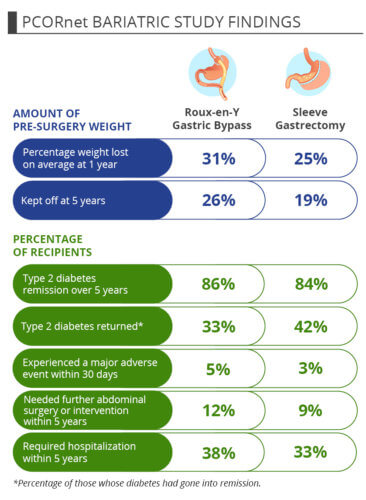
With its latest findings in JAMA Surgery on how many adults see their Type 2 diabetes go away and come back following weight-loss surgery, the PCORnet Bariatric Study now provides patients and their doctors with a more complete picture about the comparative benefits and risks of the two most commonly used surgical procedures. This real-world evidence enables patients in consultation with their providers to make more personalized decisions about which option would be best for them.

Drawing from the resources of PCORnet®, the National Patient-Centered Clinical Research Network, the PCORnet Bariatric Study is the largest study to date to compare the longer-used Roux-en-Y gastric bypass procedure and the newer and somewhat simpler approach called sleeve gastrectomy. Its findings are based on analyses of data from tens of thousands of bariatric recipients securely accessed via PCORnet.

The study, funded by the Patient-Centered Outcomes Research Institute (PCORI), previously reported findings on how these two procedures compare in weight loss and maintenance among adult patients in Annals of Internal Medicine along with rates of short-term health risks. Findings about rates of long-term problems requiring reoperations and other interventions appeared in JAMA Surgery.
Now with PCORI funding, the PCORnet Bariatric Study’s findings are being incorporated into a decision aid to empower patients, in consultation with their clinicians, to make personalized decisions about weight-loss surgery.

“More people with severe obesity should be having conversations about the role of bariatric surgery, which has been underused because of concerns about safety and weight regain,” said the study’s lead co-principal investigator David Arterburn, M.D., M.P.H., an internist and senior investigator at Kaiser Permanente Washington Health Research Institute in Seattle. “The results of the PCORnet Bariatric Study show that the overwhelming majority of patients maintain successful weight loss long term, especially after bypass. But bypass patients had a higher risk of subsequent operation and hospitalization.”

“As with many health care options, no one weight-loss surgical procedure is the best choice for every patient because tradeoffs are associated with each,” added co-principal investigator Kathleen McTigue, M.D., M.P.H., M.S., an associate professor of medicine and epidemiology at the University of Pittsburgh. “The choice requires personalized decision making that involves weighing the evidence about the pros and cons along with each person’s individual circumstances and preferences.”

Because of the large sample sizes that the researchers could assess through PCORnet, they could examine subgroups of people to assess whether certain characteristics improved or worsened their chance of weight loss success. They found that men, African Americans, Hispanics, people age 65 and older, and people with diabetes or lower body mass index (less than 50) tended to lose less weight than did other people in the study.

But these differences between patient groups were small—less than 3 percent differences in weight lost at 1, 3, and 5 years across groups—which was much less than the differences between the procedures.

Both PCORnet and PCORI emphasize patient guidance and partnership in studies. People who have had weight-loss surgery served as co-investigators and helped to refine the study question, select outcomes to study, interpret the findings and present the results. Neely Williams, M.Div., who has served as patient co-principal investigator for the study, noted that having gastric bypass has helped her, but this study’s results would have been helpful at the time of her surgery decision because she was not sure which procedure was best for her. Her pre-surgery screening did not offer details, and she didn’t know what questions to ask. As a partner in the study, she was able to call attention to things that may or may not have been considered by the people who were doing the research.

Developed with funding from PCORI, PCORnet harnesses the power of real-world data drawn from electronic health records, claims data and other sources to generate real-world evidence. The network enables researchers to access aggregated, de-identified data to conduct research on large sample sizes.

PCORnet® Study ADAPTABLE Inspires New Tools to Rapidly Compare Data from EHRs and Patient-Reported Data

The ADAPTABLE study broke ground as the first major randomized comparative effectiveness trial conducted using the infrastructure of PCORnet®, the National Patient-Centered Clinical Research Network. Now, a team of researchers building on the learnings of ADAPTABLE is raising the research bar with the development of a new menu-driven query (MDQ) that enables rapid comparison between electronic health record (EHR) data and information reported directly by patients. The MDQ is part of a larger effort supported by the National Institutes of Health Collaboratory Coordinating Center to develop and test methods for integrating patient-reported data into the EHR and to streamline data for use in pragmatic clinical trials.

Development of this MDQ is important because integrating patient-reported information and EHR-derived data allows researchers to see a more complete view of patient health. Patient-reported information can offer insights into disease manifestation that are not readily available in an EHR, including the capture of outcomes that occur outside of the patient’s primary health system. The new MDQ closes that knowledge gap by allowing users to query and integrate both.

Visit the NIH Collaboratory to learn more, including user documentation for the new MDQ and a summary of its development.

Results from PCORnet® Bariatric Study Published in JAMA Surgery

There were no differences in all-cause mortality between patients who had sleeve gastrectomy or Roux-en-Y gastric bypass (RYGB), but operations, hospitalizations, and other longer-term problems were more often associated with RYGB than sleeve gastrectomy, according to a new JAMA Surgery paper reporting results from the PCORnet® Bariatric Study.

The paper describes how researchers used resources from PCORnet, the National Patient-Centered Clinical Research Network, to build a cohort of over 33,000 patients who underwent one of these two different types of bariatric surgery. Researchers were able to investigate the rates of longer-term problems up to five years after patients had their bariatric surgeries.

In an audio interview, study author Anita Courcoulas, MD, MPH, FACS, said that this research was different from past studies in that, by using PCORnet, researchers were able to leverage real-world clinical data from electronic health records and link that data to insurance claims data and other sources.

This information will help guide patients and their doctors in making important decisions about bariatric surgery as they weigh the rates of potential risks associated with each procedure and the average amount of weight loss produced by each, she noted. Study findings on how much weight patients lost and kept off were published in an earlier paper in the Annals of Internal Medicine.

Courcoulas also discussed the important role that bariatric patients, including co-investigator Neely Williams helped in shaping and guiding the study at every step.

PCORnet Leader Rainu Kaushal Elected to Prestigious National Academy of Medicine

Dr. Rainu Kaushal wears many hats. She serves as the principal investigator for INSIGHT-NYC, a Partner Network of PCORnet®, the National Patient-Centered Clinical Research Network; chair of the Department of Healthcare Policy and Research at Weill Cornell Medicine; physician-in-chief of healthcare policy and research at New York-Presbyterian/Weill Cornell Medical Center, and a member of the PCORnet Steering Committee. Now, in recognition of her outstanding achievements and exceptional service in medical sciences, healthcare and public health, Dr. Kaushal is donning a new hat, that of an elected member of the National Academy of Medicine (NAM). NAM members are selected by their peers, and membership is one of the highest honors in health and medicine.

“I’m incredibly honored to have been elected to the National Academy of Medicine, which is such an important institution for improving health and informing healthcare policy,” said Dr. Kaushal. “My work with PCORnet has influenced many of the efforts NAM cited in their recognition, so I owe thanks to the numerous colleagues across my PCORnet family who have inspired me, challenged me, and made my science better over the years.”

For more than 25 years, Dr. Kaushal has made significant contributions to pediatric patient safety, health information technology, and value-based healthcare delivery. An information scientist and health services researcher, Dr. Kaushal’s work has influenced healthcare policies and the clinical research landscape in the United States. She was a founding member of the INSIGHT-NYC and a key contributor in helping build and expand PCORnet’s infrastructure since the Network was launched. Results from a PCORnet-enabled study she led that characterized patients with preventable high care utilization attracted over $500,000 in cost-matching from three health systems and inspired changes in population health management programs nationally.

“So many of the principles I’ve learned developing and building a clinical research network have complemented and improved my work,” said Dr. Kaushal. “My affiliation with PCORnet has without a doubt helped bring more patient-centeredness into my research, and it has been rewarding to watch the development of the Common Data Model and PCORnet’s data linkages to other sources continue to grow.”

Dr. Kaushal earned her medical degree from Harvard Medical School and completed her clinical residency as an inaugural resident at a combined program at Brigham and Women’s Hospital and Children’s Hospital in Boston, becoming board-certified in both internal medicine and pediatrics. An author of over 200 papers in various scientific publications, Dr. Kaushal is a frequently invited speaker at national and international meetings as an expert on patient safety, healthcare information technology and value-based care. Her many awards and recognitions include selection in the Executive Leadership in Academic Medicine program and being named one of the Crain’s Notable Women in Healthcare in New York City in 2018.